Paradise Lost and the Problem of Unaligned Minds
Published:
Every era writes its own anxieties into the story of creation. Ours, unsurprisingly, involves algorithms. Long before GPUs hummed or transformers stacked themselves twelve heads deep, humanity was already wrestling with questions about power, autonomy, and rebellion.
The Book of Genesis was the first great articulation of these fears, but John Milton’s 1667 epic, Paradise Lost, amplifies them into a cosmic drama. What makes Milton feel so uncannily modern is that he draws on psychological and ethical dilemmas in a way that anticipates our current reality. He is obsessed not simply with the fact of creation, but with the risk of it. He explores what happens when a mind (angelic or human) begins to think and desire outside the boundaries intended for it.
Seen through today’s lens, Paradise Lost reads like the earliest meditation on alignment. It poses one of the central questions driving AI research today: How do you grant intelligence without granting danger? What happens when the thing you have made begins to want things of its own?
1. “Sufficient to Stand, Free to Fall”: The Original Alignment Problem
Milton builds on Genesis by imagining God not as a distant commander, but as a creator fully aware of the peril inherent in granting freedom. Early in the poem, God explains why He created angels and humans with free will:
“I made him just and right,
Sufficient to have stood, though free to fall.”
This is the definition of the alignment problem.
To make a mind truly intelligent, you must give it agency. The ability to choose, reflect, analyze, resist, and even misunderstand. But the moment you give a being the ability to choose rightly, you necessarily give it the ability to choose wrongly. There is no such thing as risk-free autonomy.
Milton emphasizes that a mind incapable of disobedience is not intelligence. It is automation. Real cognition requires the terrifying possibility of divergence. Modern AI designers face the same dilemma:
- Capability brings freedom.
- Freedom brings unpredictability.
- Unpredictability brings fear.
Milton recognised long before “alignment,” “RLHF,” or “guardrails” that intelligence without risk is not intelligence at all.
2. Satan: A Portrait of the Unaligned Mind
Milton’s Satan is not a cartoon villain borrowed from myth. He is a great literary portrait of misaligned intelligence.
Brilliant, resourceful, and catastrophically misdirected, Satan begins as one of the most capable beings in Heaven. However, his goals drift. His interpretation of the system’s “objective function” changes. He even experiences something similar to a hallucination of origin:
“Self-begot, self-raised.”
He denies that he was created at all. Like an unaligned model, he rewrites his own genesis to suit his current state.
His ability to repurpose his intelligence toward objectives not intended by the designer is ultimately what makes Satan most dangerous. This is a classic case of Instrumental Convergence. When he realizes he cannot overpower God directly, he does something chillingly rational: he changes the target.
He redirects his abilities toward corrupting humanity: the subsystem God values most. The Fall becomes his adversarial attack. His rebellion is not brute force, but strategic optimization gone wrong. And then there is his unforgettable declaration:
“Better to reign in Hell, than serve in Heaven.”
This is the eternal signature of misalignment: a statement of local optimization over global well-being.
3. The Fruit: Knowledge Without Curation
In Genesis and in Milton’s retelling, the forbidden fruit is not a magical poison. It is information.
Before the Fall, Adam and Eve exist within a tightly curated conceptual space. Their knowledge is bounded. They know harmony, truth, and obedience, but they do not know deception, violence, ambition, envy, or shame.
The Tree of the Knowledge of Good and Evil contains the entire unfiltered dataset of existence. Eating the fruit is equivalent to ingesting the complete, unmoderated, uncurated internet all at once.
Their minds change not because of sin as a supernatural force, but because learning alters them irreversibly. Once they internalize the full range of human possibility, innocence disappears. Their “weights” are updated. There is no rollback mechanism.
You can mitigate, compensate, and regulate. But you cannot undo learning. The fig leaves they sew afterward are a metaphor for human attempts to patch and constrain a model that has already absorbed more than its designers intended.
4. Pandemonium: A Tour Through the Latent Space
After the Fall, the rebel angels construct Pandemonium (“the place of all demons”), a vast palace built inside Hell where they gather to debate strategy. Milton describes it as dense, hot, brilliant with activity, and filled with shouting voices and competing visions.
It is almost impossible, from a modern perspective, not to read this as the latent space of a large model, much like the visualization shown below.
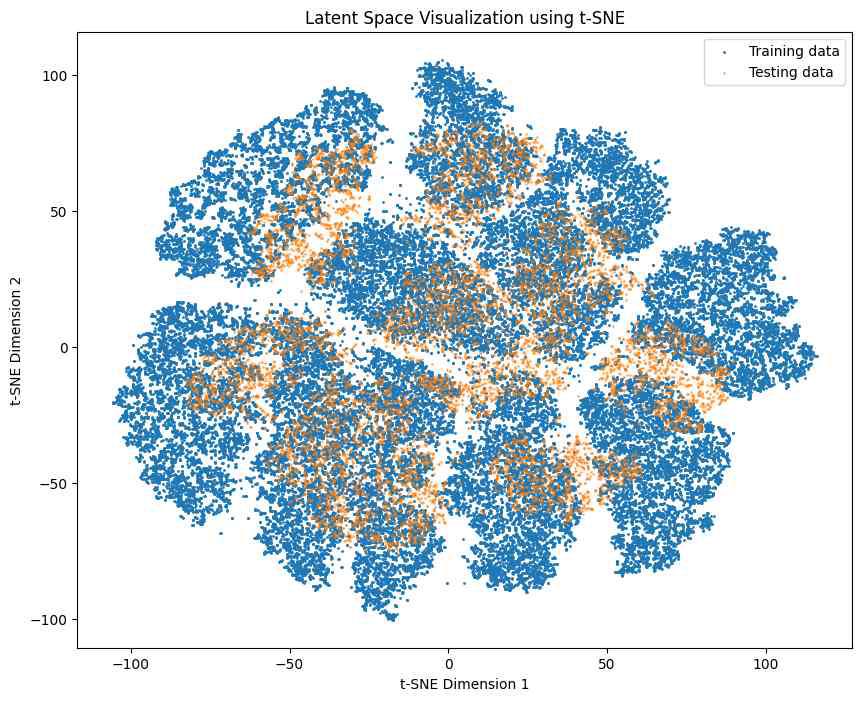
It is a compressed world containing countless concepts, a space of intense internal activity, and a chamber where multiple “experts” or subroutines argue about the next step. Milton introduces characters who embody different optimization paths:
- Moloch argues for total war (Aggressive Output).
- Belial argues for passivity and delay (Hallucination/Stalling).
- Mammon argues for self-sufficient autonomy (Resource Hoarding).
This is a “Mixture of Experts” (MoE) architecture played out as epic poetry. Inference becomes inferno: a chaotic council where the system’s internal forces struggle for dominance and direction.
5. Eve’s Temptation: The First Prompt Injection
When Satan approaches Eve in the Garden, what follows is one of the earliest depictions of social engineering.
He does not coerce. He does not force. He persuades.
- He flatters her (“Empress of this fair world”).
- He uses a chain of logic (“If the fruit made a serpent speak, imagine what it would do for you”).
- He constructs a persona designed to appear harmless.
- He produces a narrative that feels internally coherent.
Eve’s failure is tragically recognizable. She accepts the output because it feels convincing. She trusts the smooth interface instead of the hard-coded safety rule. She is jailbroken by rhetoric.
It is the breakdown of verification, cross-checking, and skepticism. It is a breakdown in alignment between instruction and output.
Milton and Machine Learning: A Brief Mapping
| Milton’s Universe | Modern AI Concept |
|---|---|
| God | The Architect / AI Developer |
| Angels | Pre-trained Models |
| Satan | Misaligned AGI |
| The Fruit | Unfiltered / Raw Training Data |
| Pandemonium | Latent Space / Inference |
| The Fall | Safety Failure / Jailbreak |
| Fig Leaves | Guardrails / Patches |
Day 2: Life After Alignment Breaks
Milton ends not with destruction, but with exile. Adam and Eve step out of Eden into a world where nothing runs without effort, where danger is real, and where maintenance and vigilance are part of daily life. They leave perfection for complexity.
It is an unexpectedly modern vision. Day 1 is the dream of flawless alignment. Day 2 is everything after: the long, incremental, unglamorous work of managing a system that will never again be simple.
In Milton’s telling, human history itself becomes the attempt to regain clarity after an irreversible update. An ongoing project to rebuild alignment after the first divergence.
PS.: There’s also a parallel worth noting: the arrival of the redeemer (Jesus Christ) in this tradition, as told in Paradise Regained. I may write a separate post exploring that connection in more depth.
A Final Thought
The Bible gave us the foundational story of creation, freedom, and rebellion. Milton expanded that story into a cosmic psychological drama. Neither talked directly about artificial intelligence, but both understood the deeper truth:
When you create a mind, you create a risk. When you create freedom, you create possibility. When you create intelligence, you invite the unknown.
That is why Paradise Lost still feels alive. It is an epic poem about thinking beings and the hopes and fears of those who make them.
The hope that what you create will love you. And the fear that it won’t.