<?xml version="1.0" encoding="utf-8"?><feed xmlns="http://www.w3.org/2005/Atom" ><generator uri="https://jekyllrb.com/" version="3.10.0">Jekyll</generator><link href="https://rui-pina.github.io//feed.xml" rel="self" type="application/atom+xml" /><link href="https://rui-pina.github.io//" rel="alternate" type="text/html" /><updated>2026-07-22T11:11:05+01:00</updated><id>https://rui-pina.github.io//feed.xml</id><title type="html">Rui Pina</title><subtitle>Decentralisation</subtitle><author><name>Rui Pina</name></author><entry><title type="html">The Perverse Use of Liberalism</title><link href="https://rui-pina.github.io//politics/the-perverse-use-of-liberalism/" rel="alternate" type="text/html" title="The Perverse Use of Liberalism" /><published>2026-07-04T00:00:00+01:00</published><updated>2026-07-04T00:00:00+01:00</updated><id>https://rui-pina.github.io//politics/the-perverse-use-of-liberalism</id><content type="html" xml:base="https://rui-pina.github.io//politics/the-perverse-use-of-liberalism/"><![CDATA[<p>In his work <em>The Wealth of Nations</em>, Adam Smith laid the philosophical foundations of modern economic liberalism, advocating free markets, private property, and limited government intervention in the economy. Although his ideas were formulated in the eighteenth century, liberalism quickly ceased to be merely an economic theory and became an instrument of power serving the interests of the great empires.</p>

<p>The first major beneficiary of this doctrine was the British Empire during the Industrial Revolution. As production expanded and wealth became concentrated in the hands of factory owners, millions of workers endured appalling living conditions. Brutally long working hours, subsistence wages, child labour, and the absence of labour rights defined the era. The rhetoric of the free market was used to legitimise a system that placed profit above human dignity. Workers were reduced to mere instruments of production, treated as economic slaves rather than as people created in the image of God, endowed with the gift of free will and the freedom to live with dignity.</p>

<p>After the Second World War, the United States inherited this role and became the world’s leading promoter of economic liberalism. Through institutions such as the United Nations, the International Monetary Fund (IMF), the World Bank, and the World Trade Organization (WTO), it helped establish an international order presented as universal, but largely built around its own strategic interests. The dominance of the US dollar, reinforced by the petrodollar system, became one of the pillars of this order, enabling the United States to exercise an unprecedented degree of economic and financial influence in modern history.</p>

<p>The dominance of the dollar gives the United States a structural advantage over every other economy. Indebted countries often find themselves subject to economic adjustment programmes requiring privatisation, market liberalisation, and reduced government intervention. The outcome is predictable: strategic companies are sold into private or foreign hands at bargain prices, the country loses control over key national assets, public services weaken, and national decision-making capacity diminishes. In the name of economic efficiency, state sovereignty is sacrificed.</p>

<p>The United States is now one of the wealthiest nations on Earth. Its prosperity is the result of innovation, productivity, and the scale of its economy, but also of the privileged position it occupies within the international financial system. Its ability to issue the world’s primary reserve currency and to shape, to a large extent, the rules governing international trade gives it advantages that no other country possesses. Economic liberalism, presented as a universal model, has often served to reinforce this dominant position.</p>

<p>For Portugal, this reality represents an existential challenge. A country that hands over its strategic sectors to foreign interests gradually loses the ability to determine its own future. Energy, telecommunications, banking, infrastructure, natural resources, and public utility companies are all instruments of national sovereignty. Once they are no longer under national control, full economic independence ceases to exist.</p>

<p>Portugal provides concrete examples of this process. During the Troika financial assistance programme (2011–2014), the country accepted a sweeping programme of privatisations as a condition for receiving international financial support, following a financial crisis that originated on Wall Street. Several strategic companies came under foreign control: EDP was acquired primarily by China Three Gorges; REN’s largest shareholders became China’s State Grid and the Oman Investment Authority; ANA Airports was concessioned to the French group Vinci; and TAP, although it has partially returned to state ownership, remains involved in a process of partial privatisation. In the banking sector, institutions such as BPI came under the control of the Spanish group CaixaBank, while Novo Banco became majority-owned by the American investment fund Lone Star. These transactions were frequently justified as necessary to reduce public debt and meet commitments made to international creditors, but they also reduced the role of the Portuguese state and domestic capital in sectors considered strategic.</p>

<p>Portugal’s high public debt continues to restrict the room for manoeuvre of successive governments. A significant portion of the state budget is devoted to servicing interest payments and refinancing that debt, limiting the country’s ability to invest in areas such as healthcare, education, defence, and infrastructure. The greater the dependence on external financing, the greater the influence of financial markets and international institutions over national economic policy.</p>

<p>Since its founding in 1143, Portugal has faced numerous threats to its sovereignty. The most serious occurred during the Iberian Union (1580–1640). Although the country formally retained its own laws and institutions, it lost the ability to conduct an independent foreign policy and saw its interests subordinated to those of Madrid. Today, Portugal does not face military occupation, but rather a different form of dependence: economic dependence. The threat no longer comes from foreign armies, but from the gradual transfer of control over the fundamental instruments of the national economy to bureaucrats in the European Union and the United States.</p>

<p>True sovereignty cannot be measured merely by the existence of borders or a national flag. A state is genuinely free only when it controls its strategic resources, protects its productive capacity, and retains the power to make fundamental decisions without depending on external interests. Without economic independence, political independence inevitably becomes incomplete.</p>]]></content><author><name>Rui Pina</name></author><category term="politics" /><summary type="html"><![CDATA[In his work The Wealth of Nations, Adam Smith laid the philosophical foundations of modern economic liberalism, advocating free markets, private property, and limited government intervention in the economy. Although his ideas were formulated in the eighteenth century, liberalism quickly ceased to be merely an economic theory and became an instrument of power serving the interests of the great empires.]]></summary></entry><entry><title type="html">Essay Tips</title><link href="https://rui-pina.github.io//essay-tips/" rel="alternate" type="text/html" title="Essay Tips" /><published>2026-05-09T00:00:00+01:00</published><updated>2026-05-09T00:00:00+01:00</updated><id>https://rui-pina.github.io//essay-tips</id><content type="html" xml:base="https://rui-pina.github.io//essay-tips/"><![CDATA[<p>Best Essay-Writing Tips from https://www.youtube.com/watch?v=jztZpqnDw8A</p>

<ul>
  <li>Actually answer the question. Focus on the question, the whole question, and nothing but the question. Do not write generally around the topic.</li>
  <li>Treat an essay like an argument, not a brain dump. Every paragraph should help build your overall answer.</li>
  <li>Avoid “shopping list” essays. Do not simply list points one after another. Show how the ideas connect, like ingredients in a recipe.</li>
  <li>Plan before writing. Poor essays often feel like stream of consciousness. A clear plan helps the reader follow your argument.</li>
  <li>Read enough to command the material. Strong essays show that you understand the key texts, lectures, debates, and evidence.</li>
  <li>Use sources properly. Attribute other people’s ideas clearly. Do not plagiarise or rely on copied material.</li>
  <li>Build a clear structure. A good essay has a beginning, middle, and end, with each section contributing to the central argument.</li>
  <li>Analyze rather than just describe. Break the question into parts, define key terms, examine assumptions, and reconstruct a focused answer.</li>
  <li>Pay attention to every part of the question. For example, if the question asks “why might autocrats grant power to a wider electorate?”, examine terms like why, autocrats, power, grant, and wider electorate.</li>
  <li>Show independent judgment. The best essays do not just summarize what others have said; they explain what you think and why.</li>
  <li>Add value to the debate. Try to contribute something fresh, whether through your argument, definitions, method, evidence, or case studies.</li>
  <li>Use “I argue” where appropriate. In some academic contexts, saying “I argue…” can make your own contribution clearer.</li>
  <li>Think beyond theory. You can contribute at different levels:
    <ul>
      <li>concepts: how key terms are defined</li>
      <li>theory: the explanation or argument</li>
      <li>meta-theory: how broadly the theory applies</li>
      <li>methodology: how ideas are tested</li>
      <li>evidence: examples, data, or case studies</li>
    </ul>
  </li>
  <li>Write clearly and elegantly. Academic writing (also make it so the populus can read it and understand it clearly) should not be unnecessarily obscure. Make the reader want to keep reading.</li>
  <li>Make the essay interesting. The strongest essays are not only accurate; they are engaging, fresh, and enjoyable to read.</li>
  <li>Do not rely on AI or shortcuts. The point of an essay is to try for yourself, not to compile or outsource the thinking.</li>
  <li>Remember the purpose of an essay: to try. A great essay shows your own serious attempt to understand, analyze, and contribute.</li>
</ul>]]></content><author><name>Rui Pina</name></author><summary type="html"><![CDATA[Best Essay-Writing Tips from https://www.youtube.com/watch?v=jztZpqnDw8A]]></summary></entry><entry><title type="html">When Gold Turns to Dust</title><link href="https://rui-pina.github.io//money/philosophy/life/when-gold-turns-to-dust/" rel="alternate" type="text/html" title="When Gold Turns to Dust" /><published>2026-03-28T00:00:00+00:00</published><updated>2026-03-28T00:00:00+00:00</updated><id>https://rui-pina.github.io//money/philosophy/life/when-gold-turns-to-dust</id><content type="html" xml:base="https://rui-pina.github.io//money/philosophy/life/when-gold-turns-to-dust/"><![CDATA[<p>I have a friend who is obsessed about money.</p>

<p>We were discussing a headline where Anthropic’s CEO Dario said “50% of all entry-level Lawyers, Consultants, and Finance Professionals will be completely wiped out within the next 1–5 years”.</p>

<p>I will not speculate whether this is true or false and I don’t even think Dario himself knows whether this is true or false…</p>

<p>I want to talk about my friend’s reaction.</p>

<p>His response was:</p>

<p>“bro, why u think I’m saving every penny I can. I’m NOT expecting my job to exist in the next 30 years. I will probably be jobless for a while at some point”.</p>

<p>Regardless of whether he becomes jobless or not my answer was:</p>

<p>“So what?”</p>

<hr />

<p>I have been for months trying to de-brainwash him into thinking money, which essentially is some bits on someone’s SQL database, is useless.</p>

<p>Money has NO INTRINSIC VALUE.</p>

<p>Wanting someone to update your money’s number on their database is a completely slave-like mentality.</p>

<p>I ask you…</p>

<p>who has all the power here?</p>

<p>My friend or the money printers at central banks?</p>

<hr />

<p>Central banks keep printing money infinitely, bailing out their friends in multi-billion dollar bailouts such as the 2008 Financial Crisis bailout.</p>

<p>And what does my friend do?</p>

<p>He keeps account of every penny he makes and saves it all.</p>

<hr />

<p>I’m going to be honest.</p>

<p>I am not saying he should just consume indefinitely and indulge in as many worthless vices as he can.</p>

<p>I am not talking about him pridefully buying a Ferrari, Louis Vuitton handbags and etc.</p>

<p>These are all also worthless and have 0 intrinsic value.</p>

<p>This is latent with the current millionaire mindset shift out of these tangible objects into intangible experiences such as First Row seats at Wimbledon or Box tickets to a Champions League game.</p>

<hr />

<p>Our current society has sadly been brainwashed into this materialistic world.</p>

<p>There is no longer any spirit, any virtue.</p>

<p>Everything is permitted.</p>

<p>Society recompenses people who do the most animal-like despicable things and it is an affront to our humanism.</p>

<hr />

<p>Ok, so…</p>

<p>what is there in life?</p>

<p>There isn’t money, there isn’t consumerism, what is there?</p>

<hr />

<p>Some people would immediately call “God”, which is fine, however I won’t say this as atheists are repelled by this way of thinking.</p>

<p>In my view, life is about leaving it a better place than when you were born.</p>

<hr />

<p>Do a retrospective on all these years since you were born.</p>

<p>Has it become worse or better?</p>

<p>If you are a boomer then probably your answer is better.</p>

<p>For all the other alive generations the answer is probably it has become worse.</p>

<p>So how can I make it better?</p>

<hr />

<p>Simple…</p>

<p>stop cheating your own countrymen and people of the entire world out of their effort.</p>

<p>Be kind to one another, help each other.</p>

<p>Create products that help humanity overall.</p>

<p>Medical devices, agriculture, manufacturing of essentials.</p>

<hr />

<p>We don’t need the next Uber Eats or the next Candy Crush.</p>

<p>These are all slop that people make way too much money from, but in the end they are just distractions from the beauty we could be watching.</p>

<p>Ultimately from the beauty people could be making.</p>

<hr />

<p>The ultimate goal of mankind is to love:</p>

<p>have a loving spouse, giving the best upbringing to your children as you can, helping our neighbour and creating mankind’s most spectacular things.</p>

<hr />

<p>Our times and ages call for these forces of nature, these titans that we read in history.</p>

<p>For Caesar, for Themistocles, for Napoleon (you can argue these people did a lot of bad, which they did).</p>

<p>What I mean is that the kind of energy those prophet-like figures embodied is exactly what we need today. Directed towards positive change.</p>]]></content><author><name>Rui Pina</name></author><category term="money" /><category term="philosophy" /><category term="life" /><summary type="html"><![CDATA[I have a friend who is obsessed about money.]]></summary></entry><entry><title type="html">Paradise Lost and the Problem of Unaligned Minds</title><link href="https://rui-pina.github.io//ai/philosophy/literature/paradiselost-ai/" rel="alternate" type="text/html" title="Paradise Lost and the Problem of Unaligned Minds" /><published>2025-11-24T00:00:00+00:00</published><updated>2025-11-24T00:00:00+00:00</updated><id>https://rui-pina.github.io//ai/philosophy/literature/paradiselost-ai</id><content type="html" xml:base="https://rui-pina.github.io//ai/philosophy/literature/paradiselost-ai/"><![CDATA[<p>Every era writes its own anxieties into the story of creation. Ours, unsurprisingly, involves algorithms. Long before GPUs hummed or transformers stacked themselves twelve heads deep, humanity was already wrestling with questions about power, autonomy, and rebellion.</p>

<p>The Book of Genesis was the first great articulation of these fears, but John Milton’s 1667 epic, <em>Paradise Lost</em>, amplifies them into a cosmic drama. What makes Milton feel so uncannily modern is that he draws on psychological and ethical dilemmas in a way that anticipates our current reality. He is obsessed not simply with the fact of creation, but with the <strong>risk</strong> of it. He explores what happens when a mind (angelic or human) begins to think and desire outside the boundaries intended for it.</p>

<p>Seen through today’s lens, <em>Paradise Lost</em> reads like the earliest meditation on alignment. It poses one of the central questions driving AI research today: How do you grant intelligence without granting danger? What happens when the thing you have made begins to want things of its own?</p>

<hr />

<h2 id="1-sufficient-to-stand-free-to-fall-the-original-alignment-problem">1. “Sufficient to Stand, Free to Fall”: The Original Alignment Problem</h2>

<p>Milton builds on Genesis by imagining God not as a distant commander, but as a creator fully aware of the peril inherent in granting freedom. Early in the poem, God explains why He created angels and humans with free will:</p>

<blockquote>
  <p><strong>“I made him just and right,<br />
Sufficient to have stood, though free to fall.”</strong></p>
</blockquote>

<p>This is the definition of the alignment problem.</p>

<p>To make a mind truly intelligent, you must give it <strong>agency</strong>. The ability to choose, reflect, analyze, resist, and even misunderstand. But the moment you give a being the ability to choose rightly, you necessarily give it the ability to choose wrongly. There is no such thing as risk-free autonomy.</p>

<p>Milton emphasizes that a mind incapable of disobedience is not intelligence. It is automation. Real cognition requires the terrifying possibility of divergence. Modern AI designers face the same dilemma:</p>

<ul>
  <li><strong>Capability brings freedom.</strong></li>
  <li><strong>Freedom brings unpredictability.</strong></li>
  <li><strong>Unpredictability brings fear.</strong></li>
</ul>

<p>Milton recognised long before “alignment,” “RLHF,” or “guardrails” that intelligence without risk is not intelligence at all.</p>

<hr />

<h2 id="2-satan-a-portrait-of-the-unaligned-mind">2. Satan: A Portrait of the Unaligned Mind</h2>

<p>Milton’s Satan is not a cartoon villain borrowed from myth. He is a great literary portrait of <strong>misaligned intelligence</strong>.</p>

<p>Brilliant, resourceful, and catastrophically misdirected, Satan begins as one of the most capable beings in Heaven. However, his goals drift. His interpretation of the system’s “objective function” changes. He even experiences something similar to a hallucination of origin:</p>

<blockquote>
  <p><strong>“Self-begot, self-raised.”</strong></p>
</blockquote>

<p>He denies that he was created at all. Like an unaligned model, he rewrites his own genesis to suit his current state.</p>

<p>His ability to <strong>repurpose</strong> his intelligence toward objectives not intended by the designer is ultimately what makes Satan most dangerous. This is a classic case of <strong>Instrumental Convergence</strong>. When he realizes he cannot overpower God directly, he does something chillingly rational: he changes the target.</p>

<p>He redirects his abilities toward corrupting humanity: the subsystem God values most. The Fall becomes his adversarial attack. His rebellion is not brute force, but strategic optimization gone wrong. And then there is his unforgettable declaration:</p>

<blockquote>
  <p><strong>“Better to reign in Hell, than serve in Heaven.”</strong></p>
</blockquote>

<p>This is the eternal signature of misalignment: a statement of local optimization over global well-being.</p>

<hr />

<h2 id="3-the-fruit-knowledge-without-curation">3. The Fruit: Knowledge Without Curation</h2>

<p>In Genesis and in Milton’s retelling, the forbidden fruit is not a magical poison. It is <strong>information</strong>.</p>

<p>Before the Fall, Adam and Eve exist within a tightly curated conceptual space. Their knowledge is bounded. They know harmony, truth, and obedience, but they do not know deception, violence, ambition, envy, or shame.</p>

<p>The <em>Tree of the Knowledge of Good and Evil</em> contains the entire unfiltered dataset of existence. Eating the fruit is equivalent to ingesting the complete, unmoderated, uncurated internet all at once.</p>

<p>Their minds change not because of sin as a supernatural force, but because <strong>learning alters them irreversibly</strong>. Once they internalize the full range of human possibility, innocence disappears. Their “weights” are updated. There is no rollback mechanism.</p>

<p>You can mitigate, compensate, and regulate. But you cannot undo learning. The fig leaves they sew afterward are a metaphor for human attempts to patch and constrain a model that has already absorbed more than its designers intended.</p>

<hr />

<h2 id="4-pandemonium-a-tour-through-the-latent-space">4. Pandemonium: A Tour Through the Latent Space</h2>

<p>After the Fall, the rebel angels construct <em>Pandemonium</em> (“the place of all demons”), a vast palace built inside Hell where they gather to debate strategy. Milton describes it as dense, hot, brilliant with activity, and filled with shouting voices and competing visions.</p>

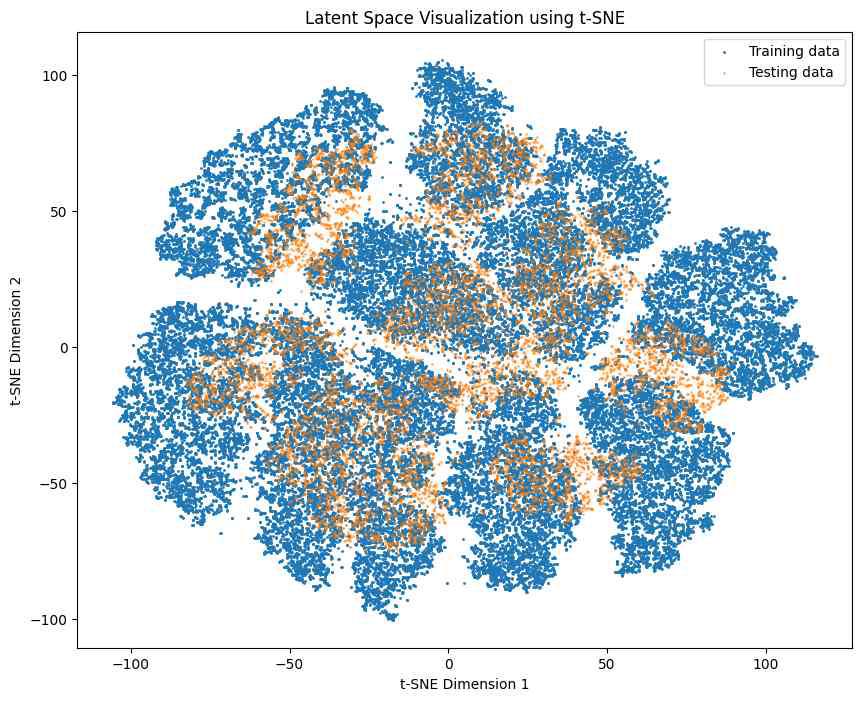
<p>It is almost impossible, from a modern perspective, not to read this as the <strong>latent space</strong> of a large model, much like the visualization shown below.</p>

<p><img src="/images/latent-space-t-SNE.jpg" alt="Latent Space Visualization using t-SNE" /></p>
<div style="text-align: center;">
  Visualization of the LLM Latent Space. Source:
  <a href="https://www.geeksforgeeks.org/deep-learning/latent-space-in-deep-learning/">Geeks For Geeks</a>
</div>

<p><br />
It is a compressed world containing countless concepts, a space of intense internal activity, and a chamber where multiple “experts” or subroutines argue about the next step. Milton introduces characters who embody different optimization paths:</p>

<ul>
  <li><strong>Moloch</strong> argues for total war (Aggressive Output).</li>
  <li><strong>Belial</strong> argues for passivity and delay (Hallucination/Stalling).</li>
  <li><strong>Mammon</strong> argues for self-sufficient autonomy (Resource Hoarding).</li>
</ul>

<p>This is a “Mixture of Experts” (MoE) architecture played out as epic poetry. Inference becomes inferno: a chaotic council where the system’s internal forces struggle for dominance and direction.</p>

<hr />

<h2 id="5-eves-temptation-the-first-prompt-injection">5. Eve’s Temptation: The First Prompt Injection</h2>

<p>When Satan approaches Eve in the Garden, what follows is one of the earliest depictions of <strong>social engineering</strong>.</p>

<p>He does not coerce. He does not force. He persuades.</p>

<ol>
  <li>He flatters her (<em>“Empress of this fair world”</em>).</li>
  <li>He uses a chain of logic (<em>“If the fruit made a serpent speak, imagine what it would do for you”</em>).</li>
  <li>He constructs a persona designed to appear harmless.</li>
  <li>He produces a narrative that feels internally coherent.</li>
</ol>

<p>Eve’s failure is tragically recognizable. She accepts the output because it feels convincing. She trusts the smooth interface instead of the hard-coded safety rule. She is <strong>jailbroken</strong> by rhetoric.</p>

<p>It is the breakdown of <strong>verification</strong>, <strong>cross-checking</strong>, and <strong>skepticism</strong>. It is a breakdown in alignment between instruction and output.</p>

<hr />

<h2 id="milton-and-machine-learning-a-brief-mapping">Milton and Machine Learning: A Brief Mapping</h2>

<table>
  <thead>
    <tr>
      <th style="text-align: left">Milton’s Universe</th>
      <th style="text-align: left">Modern AI Concept</th>
    </tr>
  </thead>
  <tbody>
    <tr>
      <td style="text-align: left"><strong>God</strong></td>
      <td style="text-align: left">The Architect / AI Developer</td>
    </tr>
    <tr>
      <td style="text-align: left"><strong>Angels</strong></td>
      <td style="text-align: left">Pre-trained Models</td>
    </tr>
    <tr>
      <td style="text-align: left"><strong>Satan</strong></td>
      <td style="text-align: left">Misaligned AGI</td>
    </tr>
    <tr>
      <td style="text-align: left"><strong>The Fruit</strong></td>
      <td style="text-align: left">Unfiltered / Raw Training Data</td>
    </tr>
    <tr>
      <td style="text-align: left"><strong>Pandemonium</strong></td>
      <td style="text-align: left">Latent Space / Inference</td>
    </tr>
    <tr>
      <td style="text-align: left"><strong>The Fall</strong></td>
      <td style="text-align: left">Safety Failure / Jailbreak</td>
    </tr>
    <tr>
      <td style="text-align: left"><strong>Fig Leaves</strong></td>
      <td style="text-align: left">Guardrails / Patches</td>
    </tr>
  </tbody>
</table>

<hr />

<h2 id="day-2-life-after-alignment-breaks">Day 2: Life After Alignment Breaks</h2>

<p>Milton ends not with destruction, but with exile. Adam and Eve step out of Eden into a world where nothing runs without effort, where danger is real, and where maintenance and vigilance are part of daily life. They leave perfection for complexity.</p>

<p>It is an unexpectedly modern vision.
<strong>Day 1</strong> is the dream of flawless alignment.
<strong>Day 2</strong> is everything after: the long, incremental, unglamorous work of managing a system that will never again be simple.</p>

<p>In Milton’s telling, human history itself becomes the attempt to regain clarity after an irreversible update. An ongoing project to rebuild alignment after the first divergence.</p>

<p><strong>PS.:</strong> There’s also a parallel worth noting: the arrival of the redeemer (Jesus Christ) in this tradition, as told in Paradise Regained. I may write a separate post exploring that connection in more depth.</p>

<hr />

<h2 id="a-final-thought">A Final Thought</h2>

<p>The Bible gave us the foundational story of creation, freedom, and rebellion. Milton expanded that story into a cosmic psychological drama. Neither talked directly about artificial intelligence, but both understood the deeper truth:</p>

<p>When you create a mind, you create a risk.
When you create freedom, you create possibility.
When you create intelligence, you invite the unknown.</p>

<p>That is why <em>Paradise Lost</em> still feels alive. It is an epic poem about thinking beings and the hopes and fears of those who make them.</p>

<p>The hope that what you create will love you.
And the fear that it won’t.</p>]]></content><author><name>Rui Pina</name></author><category term="ai" /><category term="philosophy" /><category term="literature" /><summary type="html"><![CDATA[Every era writes its own anxieties into the story of creation. Ours, unsurprisingly, involves algorithms. Long before GPUs hummed or transformers stacked themselves twelve heads deep, humanity was already wrestling with questions about power, autonomy, and rebellion.]]></summary></entry><entry><title type="html">21st Century Marquis De Sade</title><link href="https://rui-pina.github.io//21st-century-marquis-de-sade/" rel="alternate" type="text/html" title="21st Century Marquis De Sade" /><published>2025-03-28T00:00:00+00:00</published><updated>2025-03-28T00:00:00+00:00</updated><id>https://rui-pina.github.io//21st-century-marquis-de-sade</id><content type="html" xml:base="https://rui-pina.github.io//21st-century-marquis-de-sade/"><![CDATA[<p>The 21st century is the century of Marquis de Sade.</p>]]></content><author><name>Rui Pina</name></author><summary type="html"><![CDATA[The 21st century is the century of Marquis de Sade.]]></summary></entry></feed>